
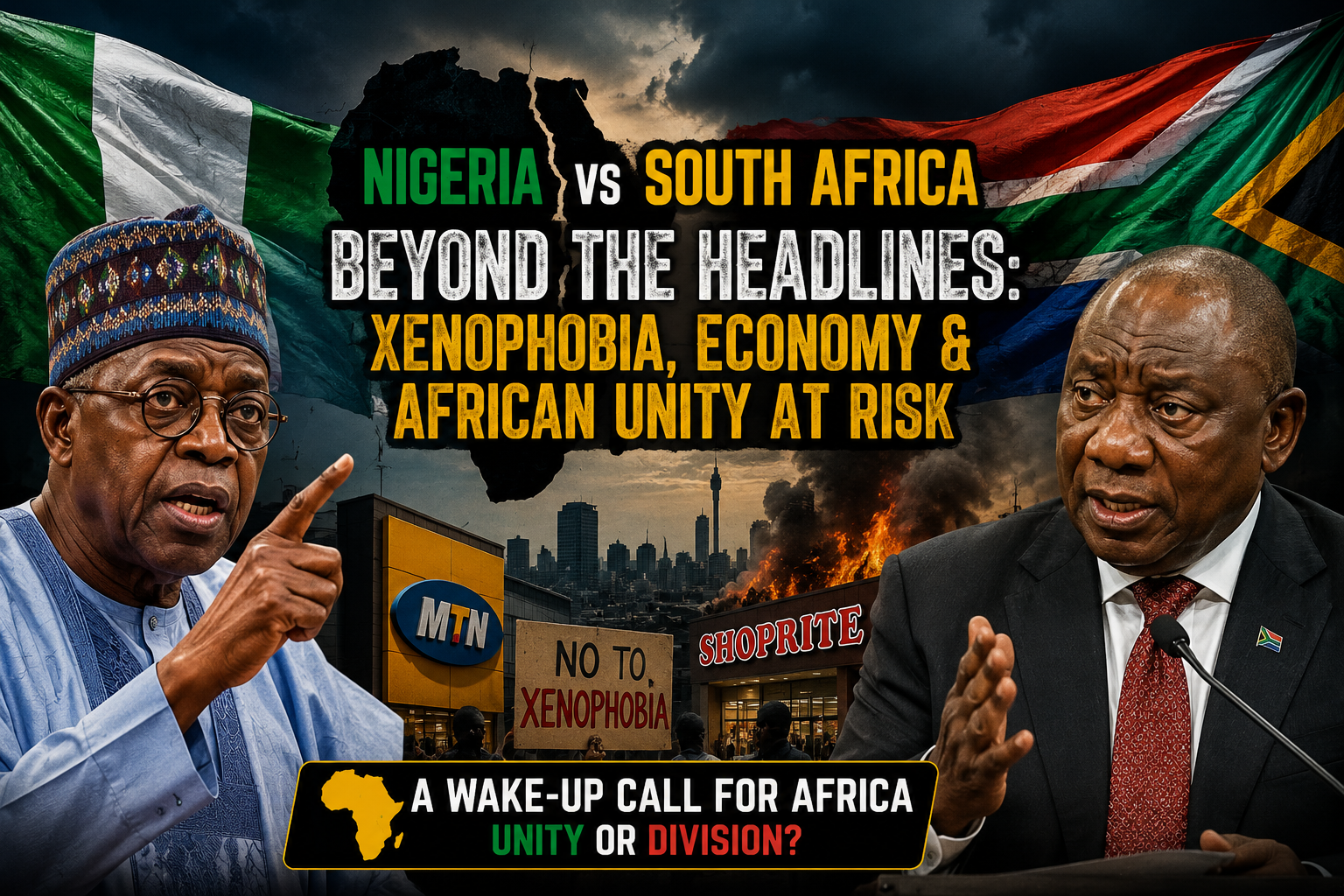
There are moments in Africa’s modern story when a single statement does more than respond to a crisis. It exposes a deeper fracture quietly sitting beneath diplomatic smiles, trade agreements, Pan-African speeches, and the carefully rehearsed language of continental unity.
“South Africans are not against people from other nations. We are one people. We are not xenophobic.”
Those words from South African President Cyril Ramaphosa may have been intended to calm tensions, but they have instead reopened one of the most uncomfortable debates facing modern Africa: whether the continent truly believes in African unity when pressure begins to rise.
The remarks came shortly after reports that members of the Nigerian Senate threatened a boycott of South African-owned businesses operating in Nigeria, including MTN Group and other major South African commercial interests. The response was triggered by renewed outrage over attacks against foreign nationals in South Africa and growing perceptions that African migrants continue to face hostility within one of the continent’s most influential economies.
But the real issue goes beyond diplomatic reactions and social media outrage.
The real issue is that Africa still struggles with trust among itself.
For years, the relationship between Nigeria and South Africa has looked powerful economically but emotionally fragile politically. On paper, these are two giants that should naturally lead the African continent toward deeper integration, stronger trade cooperation, technological advancement, and continental influence. Instead, moments of crisis repeatedly expose unresolved tensions that neither side has fully confronted honestly.
South African companies have built enormous economic footprints in Nigeria. MTN Nigeria remains one of the most influential telecom operators on the continent. South African media, retail, and financial services continue to shape major sectors of Nigeria’s economy. At the same time, Nigerians across Africa remain among the continent’s most mobile entrepreneurs, students, traders, creatives, and migrants, contributing to industries far beyond their borders.
In theory, this should be a model African partnership.
In practice, it has become a relationship constantly interrupted by suspicion.
Every time xenophobic violence erupts in South Africa, old wounds reopen. Africans remember the disturbing scenes from 2008, 2015, and 2019 when foreign-owned businesses were attacked, migrants were assaulted, and fear spread across communities that once believed Pan-Africanism meant protection and solidarity.
And this is where the discomfort begins.
Because it is no longer enough for African governments to simply deny xenophobia exists whenever violence erupts. Citizens across the continent have watched these events repeatedly. They have seen the videos. They have listened to the rhetoric. They have followed the stories of displaced migrants and targeted communities. Denial without visible systemic intervention risks sounding less like reassurance and more like political damage control.
At the same time, African societies must also resist the temptation to reduce complex economic and social frustrations into simplistic nationalist revenge.
Calls to boycott South African businesses may sound emotionally satisfying in moments of anger, but they also expose how economically interconnected African countries have already become. Nigerian consumers rely on South African telecommunications and entertainment infrastructure. South African businesses rely heavily on Nigerian markets for growth and expansion. Both economies benefit from one another in ways that are now deeply woven together.
That interdependence matters.
Africa cannot spend decades promoting continental integration only to retreat into economic retaliation every time tensions emerge. The African Continental Free Trade Area was built on the idea that African nations would move toward deeper economic cooperation, not recurring fragmentation.
Yet beneath the economic arguments lies something even more important: identity.
Why does African unity often sound strongest in conference halls but weakest on the streets?
Why do African nations sometimes cooperate more comfortably with external global powers than with each other?
And why does every diplomatic disagreement so quickly become emotionally tribal, nationalistic, or hostile?
These are the questions Nigeria and South Africa are forcing Africa to confront.
The recent reports involving Tanzania and Botswana only deepen the seriousness of the moment. Tanzanian President Samia Suluhu Hassan reportedly responded forcefully to the attacks, criticizing South Africa for allegedly failing to protect foreign nationals and warning against the humiliation of Africans in a country many once viewed as a symbol of liberation and continental struggle.
Whether every political reaction is proportionate or not, the message behind them is clear: many African nations are growing frustrated with repeated cycles of violence, denial, outrage, and diplomatic recovery without deeper structural solutions.
But this crisis also presents an opportunity if African leadership is willing to recognize it.
Nigeria and South Africa are not merely two competing states. Together, they represent a test case for Africa’s future. If these two countries can develop mature frameworks for handling disputes, protecting migrants, strengthening lawful immigration systems, addressing crime without collective blame, and preserving economic cooperation despite political tensions, they could redefine what African diplomacy looks like in the twenty-first century.
Imagine the alternative.
Imagine African economies working in synergy instead of suspicion. Imagine cross-border innovation in fintech, media, education, logistics, film, and digital infrastructure operating without recurring political hostility. Imagine Nollywood and South African cinema collaborating not as rivals but as cultural partners shaping a global African narrative. Imagine young Africans moving across the continent through structured legal systems that promote opportunity while maintaining national security and public order.
That future is possible.
But it cannot happen while African unity remains only ceremonial.
It requires leadership capable of confronting difficult truths honestly. It requires citizens willing to distinguish between legitimate concerns about crime and dangerous generalizations against entire nationalities. It requires governments that understand that securing borders and protecting migrants are not mutually exclusive responsibilities.
Most importantly, it requires Africa to stop treating internal tensions as temporary embarrassments and start treating them as structural issues demanding long-term solutions.
Because the deeper danger is not merely xenophobia itself.
The deeper danger is that Africa may gradually weaken its own continental vision through repeated cycles of distrust, retaliation, and emotional nationalism.
At a time when the global economy is becoming more competitive, fragmented, and technologically driven, Africa cannot afford to become internally hostile toward itself.
The Nigeria–South Africa tensions should therefore not be viewed merely as another diplomatic disagreement. They should be seen as a mirror reflecting the continent’s unfinished struggle between nationalism and unity, between economic integration and emotional division, between political rhetoric and social reality.
And perhaps that is the real question now confronting Africa:
Can the continent learn how to disagree without weakening itself?