
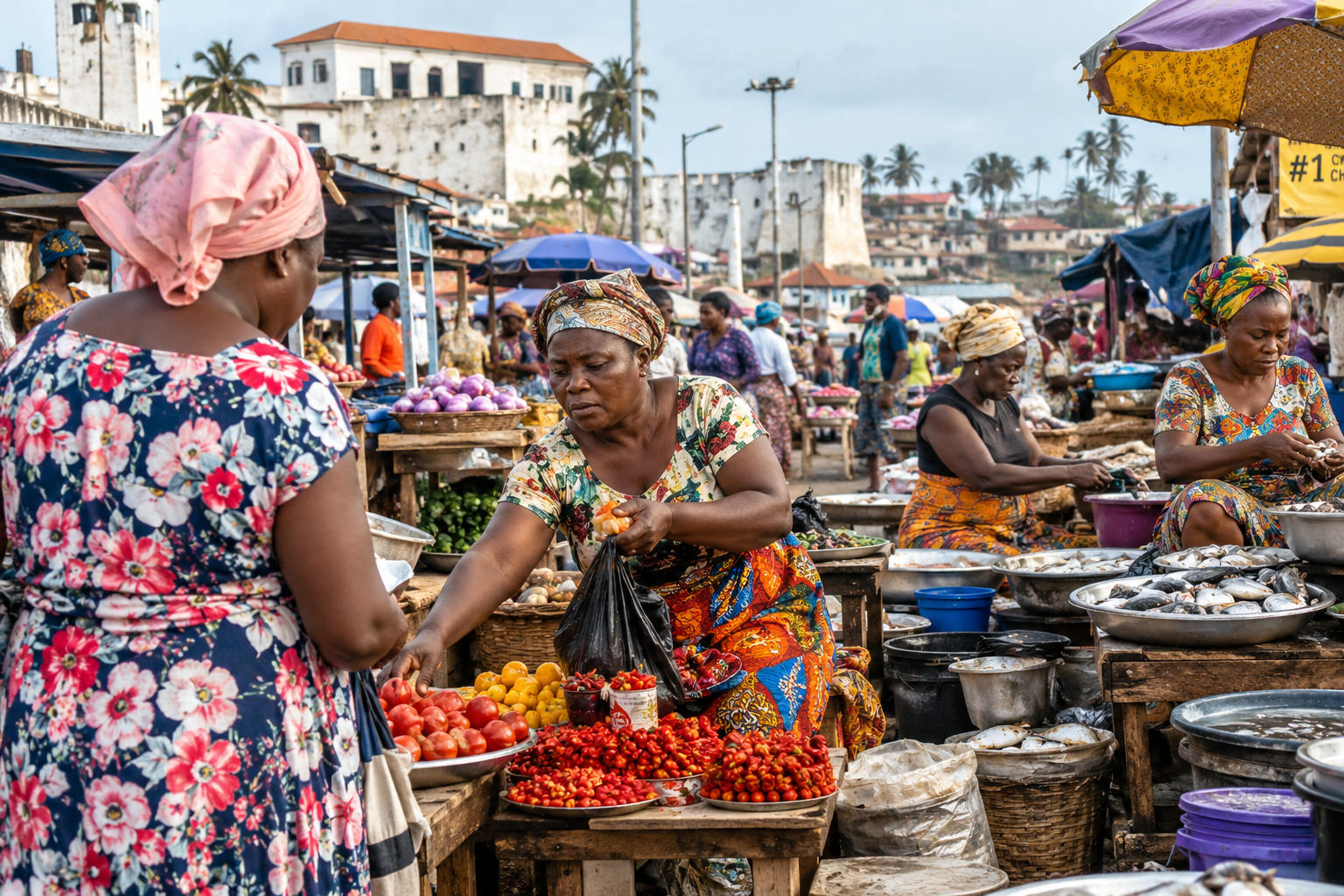
At thirteen, I knew what to do in Jukwa Market.
My grandmother would take me there on Tuesdays and Fridays, and I knew the market in the practical way a child learns a place she needs. We had come to restock the house: rice, vegetables, smoked fish, beans, and other provisions. I knew how to carry my basket and stay close to my grandmother so I would not get lost.
I remember the pink-and-white straight dress I wore. I remember the basket.
What I don’t remember is ever wondering who kept the place together.
My grandmother’s relationship with Jukwa Market was deeper than mine. She went there to buy and sometimes to sell, bringing waakye leaves, plantain and other foodstuffs from her harvest.
For me, the market was simple: you went, you bought, you went home.
Years later, at nineteen, the same grandmother would take me back into that market for a completely different reason.
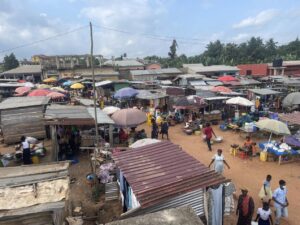
She would help me enter it again not as the child restocking a household, but as a young person trying to understand.
One day, while eating boiled yam with kontomire stew made from market ingredients, I found myself thinking about the people who had sold them.
Could someone walk into Jukwa tomorrow, put out goods and begin selling? Or was there someone they had to answer to?
I asked my mother.
She smiled and told me to ask my grandmother. So I did.
My grandmother told me there was a Market Queen who ensured that things went on smoothly.
A Market Queen?
That question took me back to Jukwa.
On Friday, 28 August 2026, my grandmother introduced me to Ma Grace Obeng, the Market Queen of Jukwa Market, and left me with my questions.
I had gone to understand how the market worked.
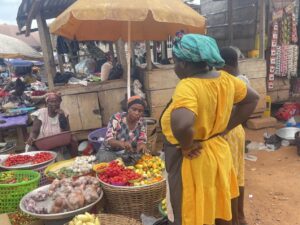
I did not know I had misunderstood what a market was.
Ma Grace told me that when the market first opened, there was no Market Queen. Someone asked why there was none. The traders searched for someone they could trust, and they chose her.
But Ma Grace had already been trusted.
Before the title, people came to her for advice. They listened to her. She spoke of her age, experience and good character. She had been called upon to help with marriage-related matters.
The title did not create the trust; the trust created the title.
And once I understood that, I began asking a different question:
What exactly does a Market Queen hold together?
Ma Grace’s answer was not ceremonial. She kept order among traders, settled disputes over money and debt, dealt with fights, enforced rules, advised people and received personal problems.
When two people disagreed, she listened to both sides. Each person gave an account. She considered what had happened, identified where the wrong lay and, in her words, “put right to right.”
Entry itself had rules.
A newcomer could not simply arrive and begin selling.
Ma Grace told me that a newcomer must first come and see her. If she agrees, she can give the person a place to sit and sell, then explains the rules.
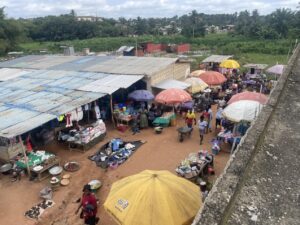
And the two rules she stressed most? “No fighting. No cursing.”
If someone repeatedly broke the rules and refused to listen, Ma Grace could take the matter to the Denkyira Hemaa.
She told me about a woman who had broken the rules more than once and eventually came through dwantoa.
I later asked my grandmother about dwantoa. She explained that an offender seeking forgiveness may come with others to plead on their behalf, or sometimes alone.
The author’s grandmother, pictured on the left, at Jukwa
In Jukwa Market, according to Ma Grace, wrongdoing had a customary path beyond confrontation: it could reach higher authority, and an offender could return through dwantoa to plead for forgiveness. The woman was forgiven.
In a Ghanaian market in Jukwa, then, order was not simply about controlling where people sold things. It also included correction, customary authority, reconciliation and a way back after wrongdoing.
Then there was cursing.
Ma Grace gave me one example in which amaneɛ and apayieɛ were performed after a curse. The person involved bought schnapps and a cock, and the traditional process was carried out.
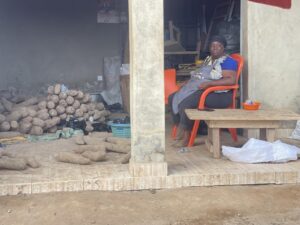
Ma Grace Obeng, Market Queen of Jukwa
My grandmother later explained that, in this context, amaneɛ involved praying to “turn” the curse so it would not work against the person. Apayieɛ was closely connected, involving gods or ancestors, water, charcoal and schnapps.
These were not traditions sitting outside the market as decoration, they were part of what held people together; ways of understanding wrongdoing, protection, restoration and consequences.
And Ma Grace had no formal training before becoming Market Queen.
A lawyer goes to school before being trained to settle disputes. Ma Grace learned by doing.
Her authority had grown from experience, conduct, reputation, and trust. Yet she was entrusted with disputes, newcomers, rules and the daily order of the market.
Some traders need capital. There is no formal market-wide fund that automatically provides it. But Ma Grace told me that friends sometimes help friends because of “love.” Traders also ask her to guarantee for them when seeking loans from Kakum Rural Bank.
Her reputation becomes economic capital.
When a trader dies, the women voluntarily contribute towards the funeral. There is no fixed amount. Two people collect it, and it is given to the deceased person’s children. Ma Grace said the contribution can reach GH₵3,000, GH₵4,000 or more.
“We hold our own power,” Ma Grace said.
Even information moves through this network. I asked how people hear about things. She laughed and said:
“It spreads on its own.”
Then Ma Grace told me something almost funny in its contradiction.
If an MP or Assemblyman wants to enter the market to campaign or make an announcement, she said, they first come to her and seek permission. Outside activities and institutions, in her account, must also see her before simply entering and doing what they want.
Apparently, even public authority knows when to knock.
When I asked about the arrangements that keep the market running smoothly, Ma Grace used the phrase dwa manso; part of her description of the market’s own arrangements and how matters are discussed and ordered.
Then, I asked, “What happens when there is no Market Queen?”
Her answer was blunt: basabasa; bad things; would happen. If there were no Queen, another Queen would be chosen.
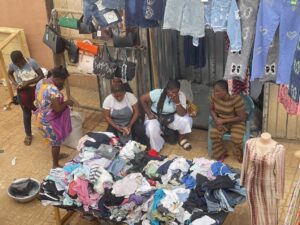
I kept thinking about that answer.
A market can look chaotic from the outside and still depend on someone who knows where a dispute belongs, who can call someone to account, and how a person who has done wrong can return. Without that authority, disputes that might otherwise be settled could remain unresolved and spread through the market.
There it was.
The Market Queen was not an ornament. She was part of what kept the market from becoming basabasa.
When I left Ma Grace that Friday, I kept looking down as I walked, partly because I was using a walking aid and partly because I did not want to make awkward eye contact with people I knew.
But the market looked different. Nothing had changed, but I had.
I noticed market women leaving goods with other market women when they went somewhere. I saw another woman’s container fall and people immediately moved to help.
Ordinary things. But now I could see what was underneath them: Trust. Obligation. Reputation. Authority. Tradition.
I had spent years looking at sellers, not knowing I had been looking at people who belonged to something.
Perhaps that is why calling Ghana’s informal sector simply “informal” can be so inadequate.
But what if we stop there? We miss what it is.
A Ghanaian market can operate outside formal bureaucracy and still have rules, authority, traditions, sanctions, obligations, systems of care and ways of making decisions.
It can be held together by women whose authority was built through years of being known. It can use relationships as infrastructure and carry traditions not as relics, but as living ways of settling, correcting, praying, forgiving and belonging.
This is why I think we need to be careful about what we see when we look at Ghana’s informal economy.
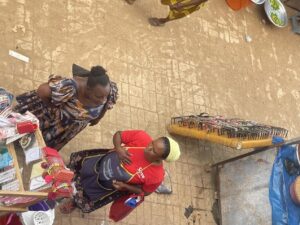
If we see only poverty, we see people who need help.
If we see only informality, we see activities that need to be formalized. But in Jukwa, I saw something else. I saw governance.
A trader may need capital, but she may also need the person whose reputation helps her access it. A market may need investment, but it already has leadership, welfare, dispute resolution, information networks and customary authority.
Development and financial interventions should ask not only what the informal sector lacks, but what is already working, and build with the trust, leadership, welfare and dispute-resolution structures within Ghanaian markets rather than around them.
My grandmother still goes to Jukwa Market on Tuesdays and Fridays.
She was the woman who took me there at thirteen and, at nineteen, helped me enter it differently.
At thirteen, I knew what we had come to buy. At nineteen, I finally wanted to know what made the place possible.
So the next time you enter a Ghanaian market, look again. Do not see only “poor.”
Do not see only “informal.” Look for the rules.
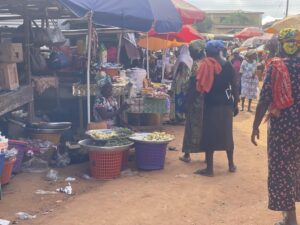
Look for the women who hold authority. Look for the traditions.
Look for the trust.
Then take those tomatoes, plantain, waakye leaves or whatever you bought home. Make your fufu. Prepare your nkate nkwan.
As you eat, remember that what reached your kitchen passed through more than a marketplace, it passed through a living social world.
A world I had walked through since I was thirteen without getting lost. Yet somehow, I had never seen it:
I had mistaken a society for a marketplace.
By: Hamdeyatu Seidu