
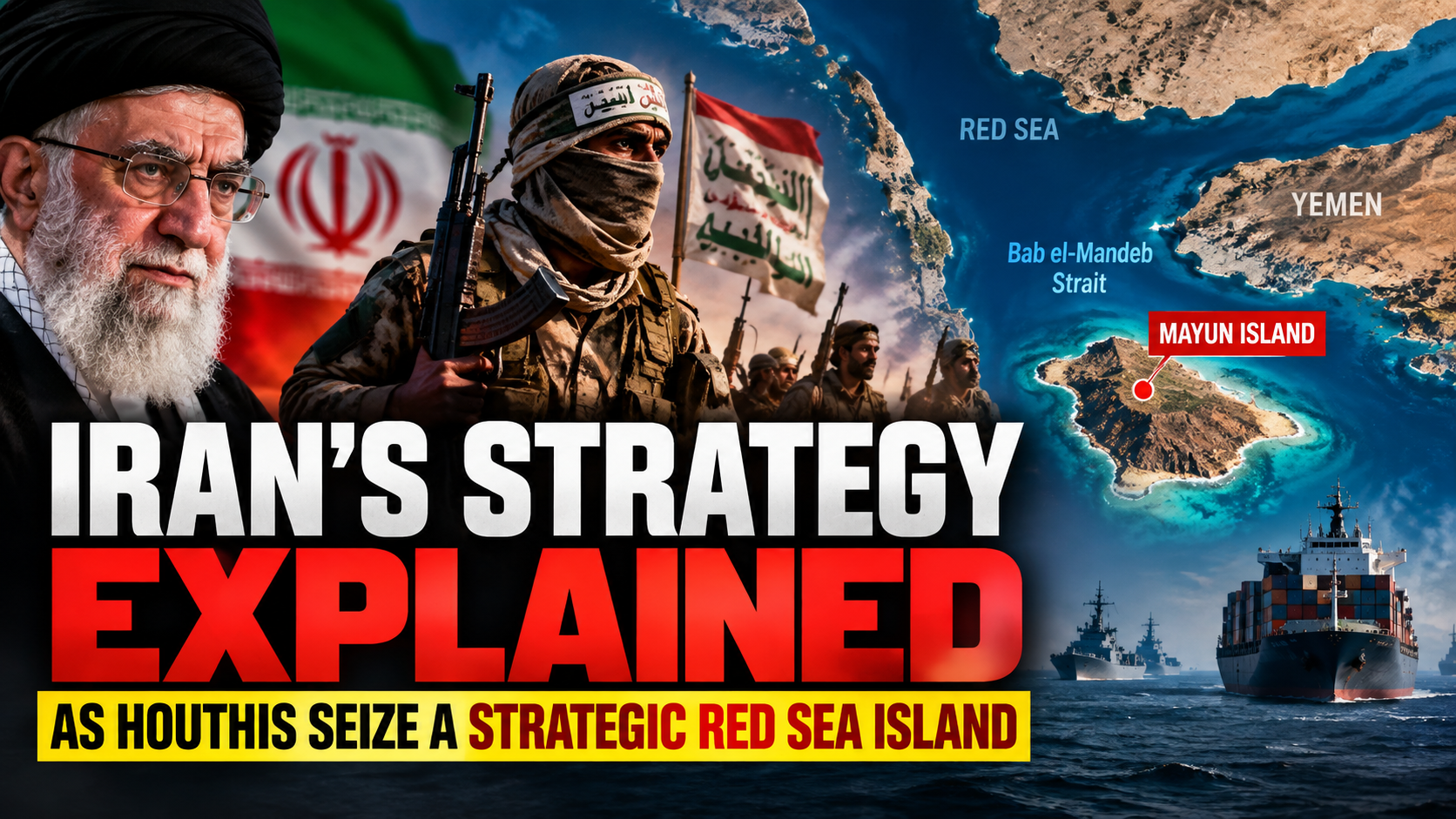
Iran’s strategy has never depended on seeking one direct, decisive confrontation with the United States. It is built around pressure from every direction: proxy forces, missile threats, attacks on energy infrastructure, cyber activity, and disruption at the world’s most important maritime chokepoints.
That broader strategy is now coming into sharper focus as Iran reportedly resumes ballistic missile production in underground facilities and Iran-backed Houthi forces expand their hold around the Red Sea.
Key Takeaways
- Iran uses proxies, infrastructure attacks, and maritime threats to avoid direct confrontation with the United States.
- The Bab el-Mandeb and Strait of Hormuz are both essential chokepoints for global trade and energy flows.
- Long-term success depends on degrading proxy weapons, supply networks, and Iran’s ability to rebuild capacity.
- U.S. industrial and military capacity remains a decisive advantage in a sustained regional conflict.
The Bab el-Mandeb Is a Major Strategic Problem
The latest concern is not simply the Houthis having another tool at their disposal. Reports that the group used Anthropic’s Claude AI in connection with missile development and identifying strategic targets may be significant, but artificial intelligence is an enabler, not the central element of the threat.
The real issue is geography.
The Houthis operate from a remote and difficult environment in Yemen. Their capture of a port previously controlled by the Saudi-backed, internationally recognized Yemeni government was already a serious development. Moving to control islands and positions around the Bab el-Mandeb Strait raises the stakes even further.
The Bab el-Mandeb is the narrow waterway connecting the Red Sea to the Gulf of Aden. It is a vital passage for commercial shipping moving between the Mediterranean, the Suez Canal, the Indian Ocean, and global energy markets.
Control or disruption of that strait creates a direct problem for the U.S. Navy and for every country relying on maritime trade through the Red Sea. The United States is now confronting pressure around two essential straits:
- The Strait of Hormuz, the critical exit route for much of the Persian Gulf’s oil and gas exports.
- The Bab el-Mandeb, the gateway between the Red Sea and the Gulf of Aden.
Both are critical to keeping the global economy moving. Neither can be dismissed as a regional concern.
Capacity Will Decide the Conflict
The central metric in this conflict is capacity.
That means the capacity of the Houthis to launch attacks, the capacity of Iran to supply its proxies and rebuild missile inventories, and the capacity of the United States to sustain military operations while protecting global shipping lanes.
Iran reportedly assembling stockpiled missile components into weapons at underground facilities illustrates why capacity matters. Underground production and storage are designed to preserve military capability after strikes and complicate efforts to degrade it.
But the United States retains a critical advantage: industrial capacity. America can build, replenish, and deploy weapons on a scale that Iran and its proxy groups cannot match. Repeated strikes can do more than reduce existing stockpiles. They can also weaken the ability to manufacture weapons, move components, receive outside support, and reconstitute forces after an attack.
That is the strategy at work: sustained pressure against not only weapons already in place, but also the networks that produce, transport, and sustain them.
Iran’s Approach Is Pressure From Every Direction
Iran and the forces it supports understand that a direct conventional war against the United States would be a losing proposition. Instead, they pursue indirect conflict.
For decades, that has meant targeting vulnerabilities wherever they can be found:
- Oil pipelines and refineries
- Commercial shipping routes
- Cyber infrastructure
- Regional allies and Arab partners
- Proxy forces capable of operating below the threshold of open war
The reported attack from Iraq threatening Saudi Arabia’s East-West Pipeline is a reminder that energy infrastructure remains a prime target. The goal is not necessarily to win through one attack. The goal is to create accumulating disruption, higher costs, uncertainty in energy markets, and political pressure on the United States and its allies.
That is why it is a mistake to focus only on the Strait of Hormuz. Hormuz remains indispensable, but the Red Sea and the Bab el-Mandeb are equally important pressure points. A campaign that threatens both can force navies, energy producers, shipping companies, and allied governments to spread their resources thinner.
Proxy Forces Are Central to Iran’s Regional Strategy
The Houthis are not operating in isolation. They are part of a wider Iranian proxy strategy that includes armed groups across the Middle East.
The purpose is to give Iran reach without requiring Tehran to openly commit its own conventional forces. Proxies can threaten shipping, launch missiles, strike infrastructure, and create instability while Iran maintains varying degrees of distance from each operation.
That is also why the response cannot stop at one group or one attack. Addressing the Islamic Republic’s regional strategy requires pressure on the broader network of armed surrogates, supply routes, weapons systems, and financial or logistical support that keeps those groups active.
There have already been significant setbacks for Iranian-backed forces, including Hezbollah and Houthi elements. The reported outreach by Lebanon’s government to Israel regarding Hezbollah’s disarmament underscores how regional pressure can reshape the political environment as well as the military one.
A Fight of Will, Resources, and Endurance
There will be pain before this is resolved. Disruption around major waterways and energy infrastructure can affect markets, shipping costs, supply chains, and regional security long before any strategic outcome is clear.
But Iran’s strategy depends on convincing its adversaries that the pressure is too costly to sustain. The answer is continued commitment, stronger protection of strategic routes, and repeated action to degrade the ability of Iran and its proxies to produce, receive, store, and employ weapons.
This is ultimately a fight of wills and capacity. The Houthis may achieve temporary success around the Red Sea, but temporary disruption is not the same as strategic victory. Sustained U.S. and allied pressure can deny Iran and its proxies the long-term objectives they are pursuing.